SIMS Hospital Saves 65-Year-Old Scholar After 250+ Shocks Using Advanced Heart Rhythm Procedure
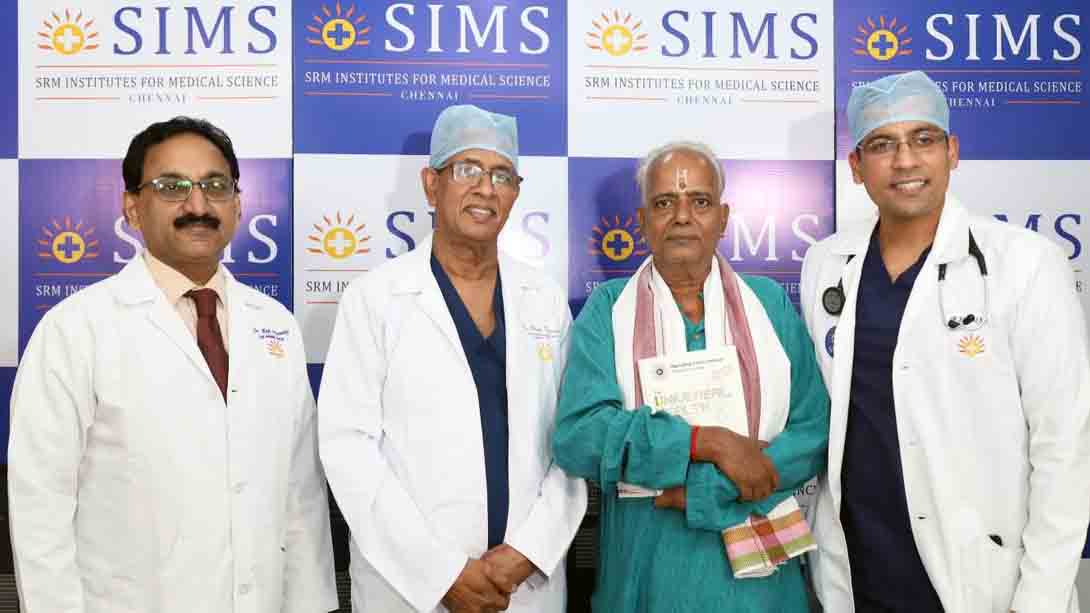
Chennai: Doctors at SIMS Hospital in Chennai saved the life of a 65-year-old religious scholar who developed a life-threatening ventricular tachycardia (VT) storm following a complex repeat coronary artery bypass surgery. The patient required more than 250 electric shocks over five days to control the dangerous heart rhythm before doctors stabilised him using an advanced electrophysiological intervention.
The patient had previously undergone coronary artery bypass grafting (CABG) in 2012 at another hospital. Recently, he began experiencing persistent chest pain and breathlessness. Investigations, including coronary angiography, revealed that several coronary arteries were critically blocked and that the earlier bypass grafts had failed. Echocardiography also showed that his heart pumping function had dropped to around 27%, and doctors detected a scarred and calcified bulge in the lower portion of the heart.
Considering the failure of the previous grafts and severely reduced blood supply to the heart, a surgical team led by Dr. V. V. Bashi, Director and Head of SIMS Institute of Cardiac & Aortic Disorders, performed a high-risk redo Coronary Artery Bypass Grafting (CABG) procedure to restore blood flow to the heart.
However, about 24 hours after surgery, the patient developed recurrent episodes of ventricular tachycardia, a dangerously rapid heart rhythm originating from the lower chambers of the heart. The abnormal rhythm did not respond to medications or specialised nerve-blocking procedures used to control severe arrhythmias. Doctors had to repeatedly administer direct-current cardioversion shocks to restore normal rhythm.
Although such arrhythmias usually settle within 48 hours after bypass surgery, the patient continued to experience persistent VT for more than five days. This rare and critical condition, known as a VT storm, required around 50 defibrillator shocks per day, totalling nearly 250 shocks. The patient was closely monitored in the intensive care unit, where a cardiologist and nursing staff remained at his bedside to deliver immediate shocks whenever the arrhythmia occurred.
An electrophysiology team led by Dr. Sanjai P. V, Clinical Lead – Cardiac Electrophysiology and Advanced Cardiac Pacing, then performed an emergency ventricular tachycardia ablation procedure to identify and eliminate the abnormal electrical circuits responsible for the rhythm disturbance.
Doctors initially performed ablation from inside the main pumping chamber of the heart. However, some abnormal signals were originating from the outer surface of the heart. Due to adhesions from previous surgeries, accessing this region was challenging. The team adopted a minimally invasive hybrid approach using a small “keyhole” incision to deliver radiofrequency energy to the outer surface of the heart and successfully eliminate the remaining abnormal circuits.
Following the procedure, the patient remained hospitalised for nearly a month, including 15 days in the intensive care unit. After stabilisation, he was discharged in good condition.
One month later, doctors implanted an Automated Implantable Cardioverter-Defibrillator (AICD) to protect the patient from future life-threatening heart rhythm disturbances. The device continuously monitors heart rhythm and automatically delivers an internal shock if a dangerous arrhythmia occurs, preventing sudden cardiac death.
Dr. Bashi said redo CABG is a complex procedure, especially in patients with previous bypass surgeries and severely impaired heart function. “In my experience of nearly 45 years, this is the first time I have seen a patient requiring such a large number of defibrillator shocks continuously over five days and still recovering successfully,” he said.
Dr. Sanjai added that the patient developed a rare VT storm originating from scarred regions within the left ventricle, including a heavily calcified area. “Using advanced 3D mapping, we were able to identify the abnormal electrical circuits and eliminate them through a combined endocardial-epicardial ablation approach,” he said.
The patient is currently recovering well and continues to remain under medical follow-up.