Real estate industry seeks review of 1-km development freeze around Pallikaranai Ramsar site
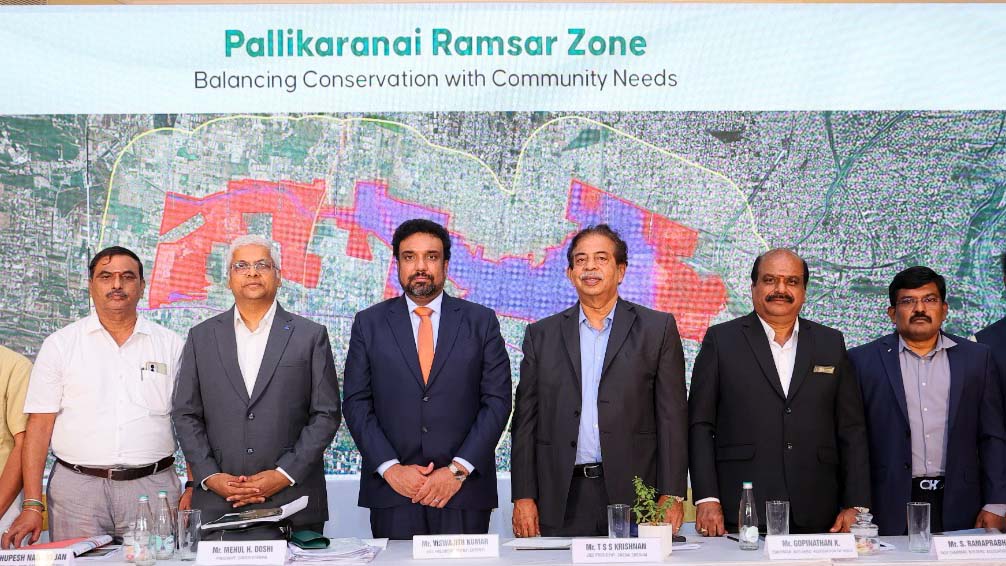
Chennai: Representatives of the real estate industry have urged the Tamil Nadu Government to adopt what they described as a balanced, scientific and consultative approach to regulations surrounding the Pallikaranai Ramsar site, expressing concerns over the recent inclusion of an additional 550 hectares of land and the implementation of a 1-km development freeze around the wetland.
According to industry representatives, the current demarcation has affected more than one lakh patta landowners. They also stated that business activity worth an estimated ₹51,735.88 crore and direct and indirect economic impact valued at ₹19,790.48 crore have been affected within the 1-km zone of influence. They said the impact could extend to construction workers, MSMEs, suppliers, transporters, service providers, professionals and other businesses linked to the real estate sector.
The industry said its concerns relate to two key issues: the identification of the additional 550 hectares included within the 1,248-hectare Pallikaranai Ramsar site, and the fixation of a uniform 1-km zone of influence around the wetland.
According to the representatives, the 698-hectare Pallikaranai Swamp Reserve Forest, notified in 2007, is already legally protected and is not under dispute. They contended that the additional 550 hectares included when the site received Ramsar status in 2022 have not yet been clearly identified through survey number demarcation, commonly referred to as ground truthing.
They further stated that the statutory process under the Wetlands (Conservation and Management) Rules, including scientific demarcation, public consultation and formal notification, has not yet been completed. The industry has requested the authorities to complete these procedures, publish detailed maps and establish the exact boundary of the Ramsar site.
On the issue of the 1-km development freeze, the representatives argued that the Wetlands (Conservation and Management) Rules require the zone of influence to be determined based on scientific factors such as hydrology, topography, drainage patterns and surrounding land use, rather than by applying a uniform distance.
They referred to the Care Earth Integrated Management Plan, cited in proceedings before the National Green Tribunal (NGT), which they said recommends that, due to the presence of patta lands and extensive urbanisation around the Pallikaranai marsh, the zone of influence should be determined based on inlet and outlet channels and associated satellite wetlands rather than a uniform 1-km boundary.
The industry also cited a response received under the Right to Information (RTI) Act, stating that the Care Earth Integrated Management Plan remains at the draft notification stage and is under examination by the Tamil Nadu State Wetland Authority.
Industry representatives said the current restrictions have affected homeowners who are unable to construct or redevelop houses, obtain housing loans, sell property or receive clarity from financial institutions and government authorities. They also noted that homebuyers are facing delays in loan approvals, including for projects that already have statutory approvals.
The representatives pointed out that several public infrastructure projects and government facilities fall within the 1-km zone, including stations under Chennai Metro Rail Phase II, existing MRTS stations, government offices, hospitals, schools, utility services, research institutions and civic infrastructure. They said the planning restrictions could also affect the proposed transit hub planned by Chennai Metro Rail at Sholinganallur.
The industry has requested the Government to review the uniform 1-km development freeze until the wetland’s influence area is scientifically determined and officially notified. It has also sought completion of scientific demarcation through ground verification and hydrological studies, approval and notification of the Integrated Management Plan following public consultation, and continuation of planning approvals, renewals, No Objection Certificates, housing loans and ongoing developments within the affected urbanised areas while the process is completed.