Former CJI U.U. Lalit Appointed Professor Emeritus at SRM School of Law
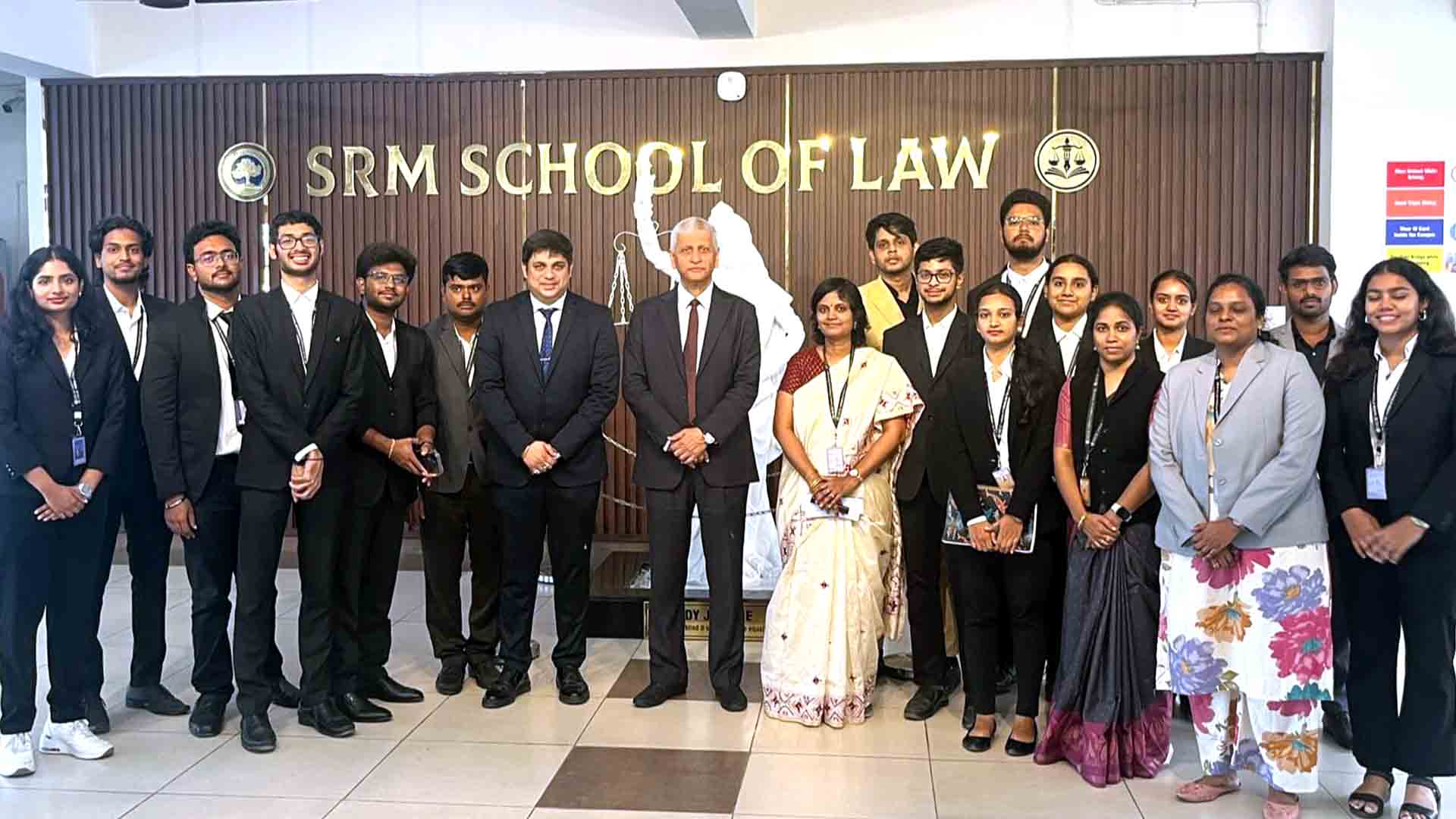
Kattankulathur: Uday Umesh Lalit, former Chief Justice of India, has been appointed as Professor Emeritus at the School of Law, SRM Institute of Science and Technology.
Widely respected for his contributions to constitutional jurisprudence, Justice Lalit is among the few jurists to have been elevated directly from the Bar to the Supreme Court. His tenure on the bench is marked by significant rulings on individual rights, gender justice, and institutional accountability.
He was part of the Constitution Bench in the landmark Shayara Bano v. Union of India, which declared instant triple talaq unconstitutional, and in Joseph Shine v. Union of India, which struck down the offence of adultery, reaffirming the principles of dignity, equality, and personal autonomy.
During his visit to the SRMIST campus, Justice Lalit delivered a lecture on “Parliamentary Privileges,” examining their constitutional basis and contemporary relevance. Tracing their origins to the evolution of the British Parliament, he explained how these principles were adapted within the Indian constitutional framework.
He emphasised that parliamentary privileges are essential for ensuring the independence and effective functioning of legislative bodies. “Parliamentary privileges are not personal advantages, but institutional safeguards designed to preserve the dignity, independence, and effectiveness of legislative bodies,” he said.
Referring to Article 194 of the Constitution, which outlines the powers and privileges of State Legislatures, Justice Lalit noted that while the Constitution provides the framework, their scope has evolved through judicial interpretation. He stressed the importance of harmonising legislative privileges with fundamental rights and broader constitutional principles.
Citing key judgments, he referred to M.S.M. Sharma v. Sri Krishna Sinha, highlighting tensions between legislative privilege and press freedom, and Tej Kiran Jain v. N. Sanjiva Reddy, which upheld immunity for statements made by legislators within the House.
He also mentioned the advisory opinion in In Re: Powers, Privileges and Immunities of State Legislatures, noting its role in balancing legislative autonomy, judicial review, and fundamental rights.
Encouraging students to develop strong legal reasoning, Justice Lalit urged them to read judgments in their entirety and understand the context in which legal principles evolve. He cautioned that fragmented reading of case law can lead to incomplete interpretations.
Commenting on the appointment, Prof. P. Sree Sudha, Dean, SRM School of Law, said, “At SRM, we believe the law is best learned from those who have shaped it. It is a profound honour to welcome Justice Lalit as our Professor Emeritus. His presence transforms textbook theory into living inspiration.”
An interactive session followed, where students raised questions on constitutional interpretation, legislative powers, and judicial oversight. Justice Lalit highlighted the importance of clarity of thought, consistency in reasoning, and adherence to professional ethics.
He also encouraged disciplined reading habits and a strong grounding in constitutional principles to navigate complex legal challenges. The session was attended by faculty members and students, and concluded with a vote of thanks.